Swiss CV: the complete guide to creating yours online
Everything you need to write a CV that meets Swiss standards in 2026: format, photo, work permit, ATS rules and regional expectations. 43 professional templates, PDF export. From 1 CHF/month.
Create my Swiss CVQuick answer
To write a Swiss CV, use A4 format over 1 to 2 pages, add a professional photo, state your nationality and work permit (B, C, G or L), list experience in reverse chronological order with quantified results, detail languages with CEFR levels, and never include salary expectations. Structure the sections in the expected order (personal details, profile, experience, education, skills, languages), write dates as MM.YYYY, mention references as available upon request, and export the document as a text-based PDF so applicant tracking systems can read it correctly. Create yours free at https://www.cv-builder.ch/en/ with ${TEMPLATE_COUNT} ATS-ready templates.
Why a Swiss CV is different
The Swiss job market has its own conventions, and they remain firmly in place in 2026. Unlike the US or UK, a Swiss CV includes personal details that would be unusual elsewhere: nationality, work permit status, date of birth and, in the vast majority of cases, a professional photo. Swiss recruiters receive 80 to 150 applications per opening and quickly discard documents that ignore local standards. A CV that is perfectly acceptable in France, Germany or the UK can be set aside in Geneva or Zurich within seconds. The expectations are precise: a well-structured, factual and concise document, experience listed in reverse chronological order with the most recent position first, each role described with the exact job title, company name, dates (month and year) and quantified results. 'Increased revenue by 15% in 6 months' says far more than 'responsible for sales'. Salary expectations never appear on the CV itself - they are discussed at the interview stage. References are listed as 'available upon request' unless the posting says otherwise. If your degree was obtained abroad, mention the Swiss equivalence or the recognition process under way with SERI (the State Secretariat for Education, Research and Innovation). With CV Builder, you create a CV that meets these requirements exactly.
Essential elements of a Swiss CV
- Professional photo on a neutral background (strongly recommended)
- Nationality and residence/work permit (B, C, G, L)
- Languages with CEFR levels (A1 to C2) - essential in multilingual Switzerland
- Experience in reverse chronological order with quantified achievements
- Education with recognized qualifications or Swiss equivalences
- Technical skills and relevant certifications
- References "available upon request"
- A4 format, 1 to 2 pages maximum, no salary expectations
Photo, work permit and personal details
A professional photo remains strongly recommended on Swiss CVs across all linguistic regions: Romandie, German-speaking Switzerland and Ticino. It should feature a neutral background, attire appropriate to your sector and portrait framing - no selfies, no holiday pictures, no social media filters. CV Builder lets you add and crop your photo directly in the editor. For full guidance, see our dedicated page: https://www.cv-builder.ch/en/cv-photo-switzerland . Stating your work permit is just as essential. Swiss recruiters use it as a first filter and want to know your status immediately: Swiss citizen, C permit (settlement), B permit (residence), G permit (cross-border commuter) or L permit (short-stay). EU/EFTA nationals should say so explicitly; non-EU nationals should indicate the exact permit type and its validity. Never invent a permit status - it is verifiable, and a lie is eliminatory. Our complete guide covers every case: https://www.cv-builder.ch/en/work-permit-cv-switzerland . The other personal details recruiters expect are your full name, address (at minimum city and canton), phone number with the +41 country code, a professional email address, date of birth and nationality.
The Swiss CV format: A4, length and layout
The Swiss CV uses exclusively A4 format (210 x 297 mm); the US Letter format is not accepted. Ideal length is 1 to 2 pages: one page for junior profiles with under 5 years of experience, two pages for senior professionals. Beyond two pages, Swiss recruiters will conclude that the candidate cannot summarise effectively. Margins should be 2 to 2.5 cm on all four sides. Choose a readable, professional font - Arial, Calibri, Helvetica or Garamond - at 10 to 12 pt for body text and 14 to 16 pt for headings, with line spacing of 1.15 to 1.5 for comfortable reading. Reverse chronological order is the standard expected throughout Switzerland: your most recent experience appears first, for both work history and education. Each entry includes the job title, company name, city and canton (or country if abroad), dates, and 3 to 5 concrete, quantified achievements. Avoid the functional, skills-based format: Swiss recruiters want to see your career progression, and a CV that hides its timeline raises questions. These layout rules are identical across all linguistic regions of Switzerland and are pre-configured in every CV Builder template.
Section order in a Swiss CV
- Personal information (name, address, phone, email, nationality, work permit, photo)
- Professional profile or objective (3-4 lines summarising your background and strengths)
- Work experience (reverse chronological order, most recent first)
- Education (degrees, certifications, reverse chronological)
- Technical and IT skills
- Languages (with CEFR level: A1 to C2)
- Interests (optional but valued in Switzerland)
- References (available upon request, or names and contact details)
Dates, phone numbers and Swiss conventions
Switzerland uses the date format DD.MM.YYYY with dots as separators, not slashes. For example: 15.06.2023. For employment periods, use a dash: 01.01.2020 - 31.12.2024. Phone numbers follow the format +41 XX XXX XX XX. These details may seem minor, but they immediately demonstrate your familiarity with local conventions and your attention to detail - and ATS parsers used by Swiss employers read DD.MM.YYYY dates correctly.
How the Swiss CV differs from neighbouring countries
The Swiss CV differs from French, German and Italian CVs in several concrete ways. Unlike France, the Swiss CV systematically mentions nationality and work permit. Unlike Germany, it is shorter (2 pages maximum versus 3) and does not include a cover sheet (Deckblatt). Unlike Italy, salary expectations never appear on the document - they are discussed at the interview. Language skills are detailed with CEFR levels, which is crucial in a country where four national languages coexist and where a candidate in Geneva may need a CV in French and English while a profile in Zurich will favour German and English. In German-speaking Switzerland, work certificates (Arbeitszeugnisse) from previous employers are an important part of the application dossier and are often expected alongside the CV. For concrete examples of well-built Swiss CVs, see: https://www.cv-builder.ch/en/swiss-cv-example
Regional differences: Romandie, German-speaking Switzerland and Ticino
The Swiss job market is not uniform, and each linguistic region has its own CV expectations. In French-speaking Switzerland (Geneva, Lausanne, Neuchatel, Fribourg, Valais), the style is closer to the French model: concise, polished, with a personal touch, and the cover letter remains a systematic part of the application. Key sectors include international organizations (UN, ICRC, WTO in Geneva), watchmaking, luxury and financial services - competition is strong, so standing out matters. In German-speaking Switzerland (Zurich, Bern, Basel, Lucerne, St. Gallen), the style is more factual and detailed. Recruiters value rigour, precision and thoroughness; sections for continuing education (Weiterbildung) and IT skills (EDV-Kenntnisse) are common, and the application dossier (Bewerbungsdossier) often includes copies of work certificates. Key sectors are banking, pharma (Basel region), industry and technology (Zurich). In Ticino (Lugano, Bellinzona, Locarno), the CV follows Italian conventions with a refined, carefully presented layout; the market is smaller but active in finance, tourism and architecture, with competition from Italian cross-border workers. Whatever your target region, CV Builder has templates designed for that context. Also see our guide on common mistakes to avoid: https://www.cv-builder.ch/en/cv-mistakes-switzerland
43 CV templates designed for the Swiss market
Our 43 CV templates have been created specifically to meet the expectations of recruiters in Switzerland. Whether you are applying in Romandie, German-speaking Switzerland or Ticino, you will find a design that matches your sector and profile: classic and executive layouts for banking, law and finance; modern and tech designs for IT, marketing and communications; minimalist templates for engineering, architecture and academia; creative models for design and media; and one-page formats for apprentices, students and consulting applications. Every template respects Swiss CV conventions out of the box, with dedicated space for a photo and sections for languages and work permit. All of them are ATS-compatible, meaning your CV will be correctly parsed by the sorting software used by major companies like Nestle, Novartis, UBS or Rolex. Your data is stored independently from the template, so you can switch designs at any time without re-entering anything - your content is automatically reformatted for the new layout. Browse the full gallery by style at: https://www.cv-builder.ch/en/cv-templates
ATS optimization for Swiss employers
Most large Swiss companies - Nestle, Novartis, UBS, Zurich Insurance, ABB, Roche - use applicant tracking systems (ATS) to screen CVs before a human recruiter ever sees them, and a growing share of SMEs have adopted lighter solutions such as Personio. To pass these filters, use a clean layout without complex tables or nested columns, avoid placing critical information in headers or footers, stick to standard fonts (Arial, Calibri, Helvetica), use recognisable section titles (Experience, Education, Skills, Languages), include keywords from the job posting in your experience and skills sections, and export as a text-based PDF rather than a scanned image. Skill bars, decorative icons and infographics are often unreadable for ATS parsers. Swiss specifics matter too: local ATS configurations handle CVs with photos without penalty, the work permit is a major filtering criterion that should appear early in the document, and language levels stated in CEFR terms are parsed as priority sorting data. All 43 of our templates are designed to pass ATS filters while remaining visually professional. For the complete optimization guide, visit: https://www.cv-builder.ch/en/ats-cv
What is free and what is paid
- Free: account creation with just an email (no credit card required), full CV editing, all 43 templates, live preview, saving multiple versions, LinkedIn and PDF import
- Free: unlimited drafts, template switching, colour and font customization
- Free: low-resolution PNG export for preview
- Paid (1 CHF/month or 10 CHF/year): unlimited HD PDF export without watermark
- Paid: advanced AI spellcheck and AI translation
- No commitment, cancel anytime from your account
The most affordable option on the Swiss market
You build and refine your Swiss CV entirely for free, and you only pay if you decide to export. HD PDF export costs 1 CHF/month or 10 CHF/year - compare that with Zety (2.95-7.95 USD then 23.70 USD/month), Resume.io (2.95 USD then 23.95 USD/month) or Canva Pro (11.99 CHF/month). At up to 23 times cheaper for equivalent quality and genuine Swiss market fit, the offer is built for students, jobseekers, apprentices and ORP/RAV beneficiaries. You can cancel in one click immediately after exporting, with no auto-renewal traps, no hidden fees and no minimum duration. Your data stays yours: it is stored on servers in Switzerland and Europe, GDPR and Swiss DPA compliant, and never resold.
Swiss CV trends for 2026: what is changing and what is not
The Swiss job market evolves, but the fundamentals of the CV remain stable in 2026: photo, permit, CEFR language levels, A4 over 1 to 2 pages and reverse chronological order are still the norm. What has changed is the weight of automated screening - ATS filtering is now standard at virtually every large employer, which makes clean structure and keyword alignment more decisive than ever. Recruitment processes typically follow several stages: an initial CV screening (often automated), a phone or video pre-screening of 15 to 30 minutes, one or two in-depth interviews of 45 to 60 minutes, and sometimes a practical assessment or trial day (Schnuppertag in German-speaking Switzerland). Be prepared to justify every line of your CV with concrete examples and quantified results. Swiss recruiters value honesty, consistency and punctuality - arriving late to an interview is disqualifying. Research salary benchmarks beforehand (the SECO salary calculator is a useful reference), since the question will come up even though the figure never appears on your CV. For complete preparation, see our Swiss job interview guide: https://www.cv-builder.ch/en/job-interview-switzerland-2026
The freelance CV: projects, clients and legal form
A freelance track record reads differently from a series of salaried posts. Replace the chronology of employers with your most significant assignments, giving for each the context, your exact role and the outcome. Confidentiality works as it does in finance: name the client's sector and size rather than the client, wherever your contract requires it. State your legal form, sole proprietorship or limited company, because it reassures on the seriousness of the activity and explains your administrative obligations. Finally, if you are aiming to return to employment, say so explicitly in your summary: otherwise a Swiss recruiter will wonder whether you are looking for one more assignment, and that ambiguity alone is enough to set an application aside.
Official sources and useful references
- State Secretariat for Migration (SEM) - Work permits: https://www.sem.admin.ch
- State Secretariat for Economic Affairs (SECO) - Labour market: https://www.seco.admin.ch
- Orientation.ch - Swiss career guidance portal: https://www.orientation.ch
- Public employment service - Registration and support: https://www.espace-emploi.ch
Useful guides
Our articles to help you in your job search
How to write the perfect CV for the Swiss job market in 2024
Discover the secrets to creating a CV that stands out with Swiss recruiters. A complete guide with examples and expert advice.

CV Photo in Switzerland: Rules and Advice
Everything you need to know about CV photos in Switzerland: professional standards, format, clothing, background, and when to include or omit one.

CV and artificial intelligence in Switzerland in 2026
How artificial intelligence is transforming CV writing and recruitment in Switzerland. AI tools, ATS filters and tips to stay competitive on the Swiss job market.

Swiss Application Dossier: The Complete Guide
Everything you need to know about assembling a complete Swiss Bewerbungsdossier: CV, cover letter, diplomas, work certificates, and references.

AI and Job Search in Switzerland
How artificial intelligence is transforming job search in Switzerland in 2026. ATS optimization, AI-powered tools, interview preparation, and ethical considerations.

Cover letter for Switzerland: templates and examples
Learn how to write a compelling cover letter for the Swiss market. Concrete examples and mistakes to avoid.
Related guides
CV templates: 43 professional designs for Switzerland
Modern, classic, minimalist, creative, professional, one-page and ATS-friendly: explore 43 CV templates tailored to Swiss recruiters. All included from 1 CHF/month.
ATS-compatible CV in Switzerland: pass the automated filters
Create a CV optimized for the automated screening software (ATS) used by Swiss companies. 43 ATS-compatible templates, practical tips and Swiss-specific advice.
ATS CV checker
Check whether your CV passes the automatic filters
Photo on a CV in Switzerland: rules and professional standards
Should you include a photo on your Swiss CV? Professional standards, regional differences, technical specifications and mistakes to avoid.
Templates for every profession
Choose from 43 professional templates and customize them to your image
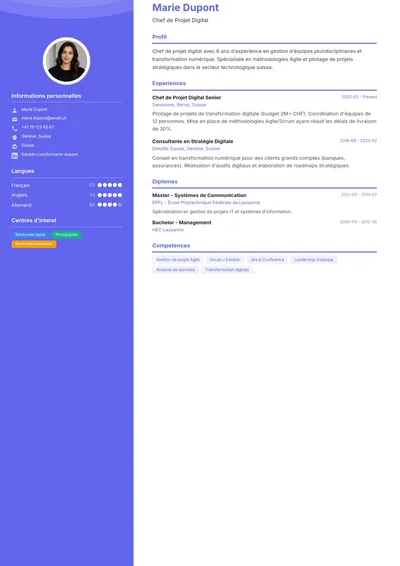
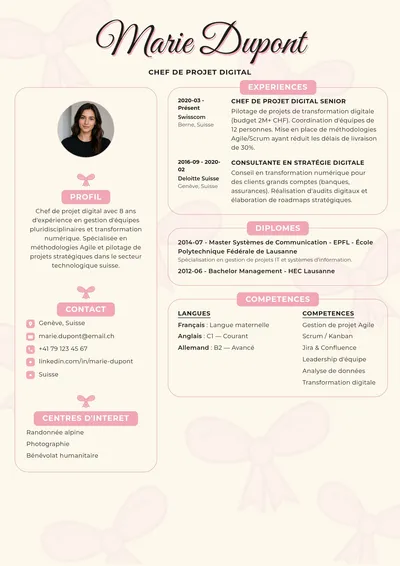
Coquette
Creative
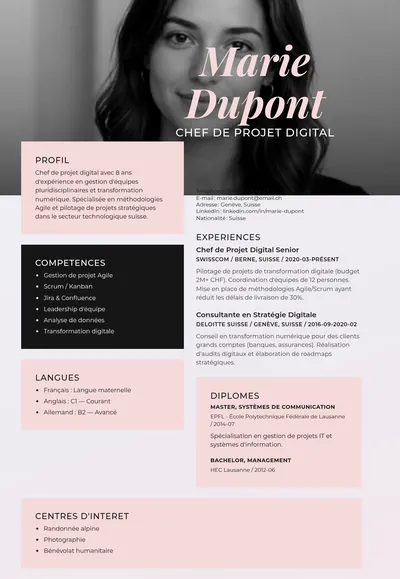
Atelier
Creative
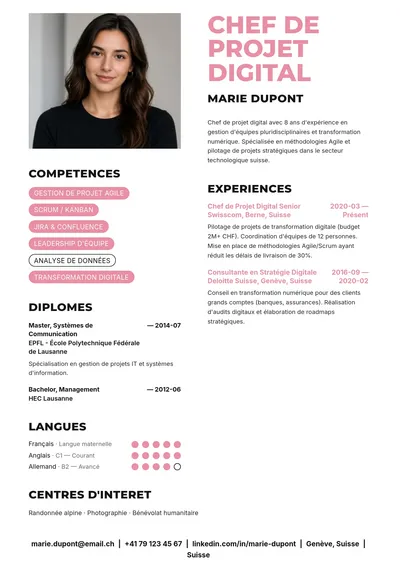
Studio
Creative
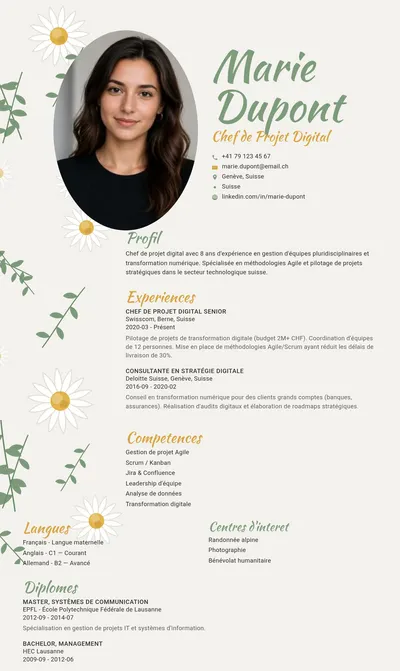
Daisy
Creative
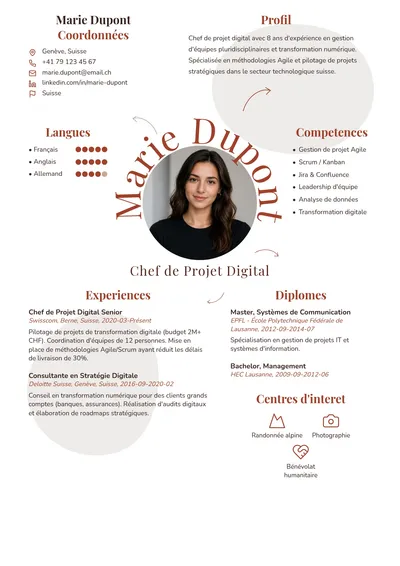
Orbit
Creative
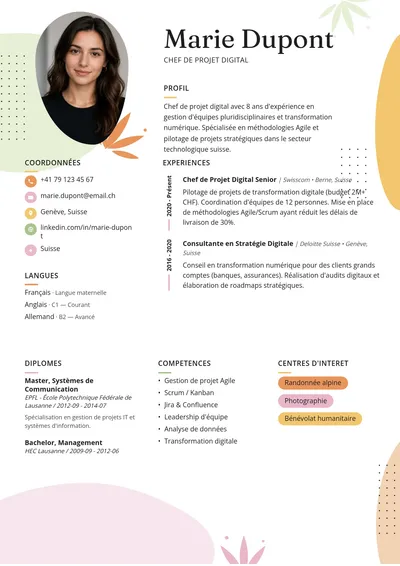
Pastel
Creative
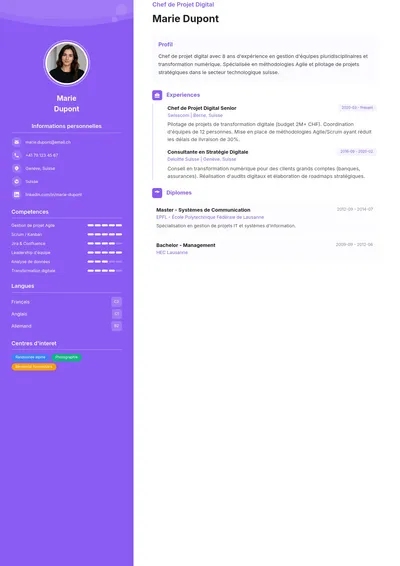
Arc
Decorative
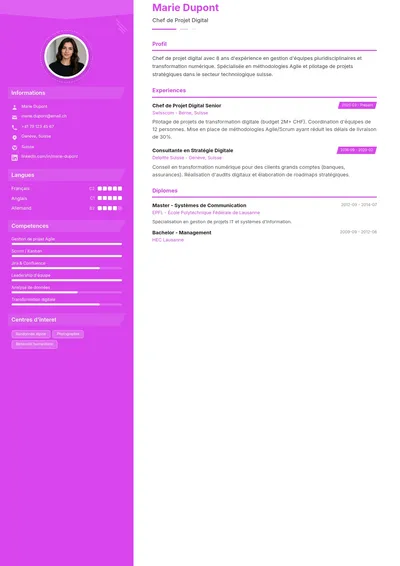
Ribbon
Decorative
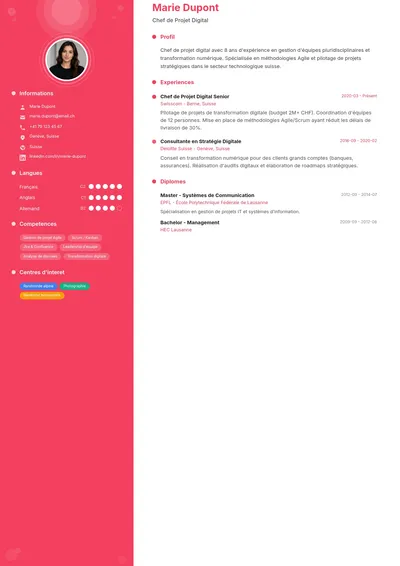
Pulse
Dynamic
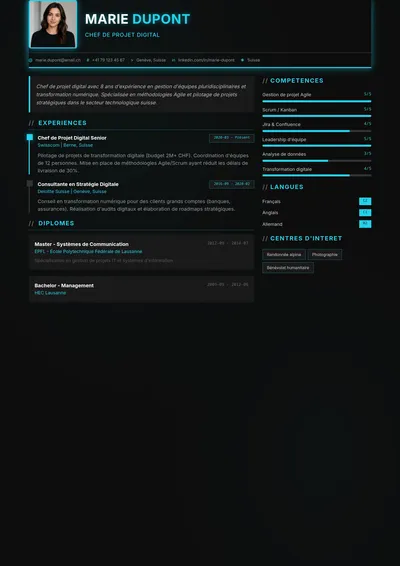
Neon
Neon
Timeline
Timeline
What our clients say
Thousands of professionals trust us to create their perfect CV
4.9/5
Average rating
10+
Customer reviews
9
5-star reviews
filipe pedro
so far so good. its working fine and the support is there to help
July 2026
panagiotis Maniatis
Excellent!
June 2026
Marcus Burkhardt
absolut perfekt und einfach zu bedienen
June 2026
Marco Reimann
Sehr gutes Tool für die CV Erstellung
einfache Handhabung, bei kleineren Problemen sehr schellen und effizienten Support erhalten.
June 2026
Olivier Sanchez
The best Swiss CV application on the market!
Fast, efficient, inexpensive, in short Impeccable..
Translated from French
June 2026
Albert Shur
Albert
I am very satisfied with this CV Builder. The tool is super easy to use.
Translated from German
June 2026
FAQ
Should I include a photo on a Swiss CV?
Yes, a professional photo remains strongly recommended across all Swiss regions in 2026. Use a neutral background, appropriate attire and portrait framing. Only a few highly international, Anglo-Saxon organizations may not expect one. CV Builder makes it easy to add and crop your photo.
How many pages should a Swiss CV be?
A Swiss CV should be 1 to 2 pages maximum on A4 format. Junior profiles (under 5 years of experience) should aim for 1 page; experienced professionals may use 2. Beyond that, Swiss recruiters will consider the candidate lacks the ability to be concise.
Should I mention my work permit on my Swiss CV?
Yes, this is essential - it is one of the first things Swiss recruiters check. State your exact status: Swiss citizen, C permit (settlement), B permit (residence), G permit (cross-border) or L permit (short-stay). EU/EFTA nationals should specify this; non-EU nationals should include the permit type and validity.
What language should I use for a CV in Switzerland?
Write your CV in the language of the job posting. In Romandie, French is standard; in German-speaking Switzerland, German; in Ticino, Italian. For international positions, English is often accepted. With CV Builder, you can create multiple versions of your CV in different languages.
What date format and structure should a Swiss CV follow?
Use the Swiss date format DD.MM.YYYY with dots (e.g. 15.06.2023) and reverse chronological order: most recent experience first. The functional, skills-based format is discouraged because Swiss recruiters want to see career progression. Phone numbers follow +41 XX XXX XX XX.
How do I optimize my CV for Swiss ATS systems?
Use a simple layout without complex tables, standard section titles, fonts like Arial or Calibri, keywords taken from the job posting, and export as a text-based PDF. Avoid placing key information in headers or footers. All our templates are ATS-tested. Full guide: https://www.cv-builder.ch/en/ats-cv
Is CV Builder really free?
Yes, creating and editing your CV is entirely free: no credit card at sign-up, access to all 43 templates, unlimited edits, preview and saving. Only the HD PDF export is paid, from 1 CHF/month or 10 CHF/year, with no commitment and one-click cancellation.
Can I switch templates without losing my data?
Yes. Your data is stored independently from the template, so you can test every design and switch at any time. Your content is automatically reformatted for the new layout - useful for preparing a classic version for corporate roles and a modern one for startups.