CV for working in Bern: the federal capital and its hiring codes
Build a CV that fits how the federal capital hires: formal dossiers for the Confederation and para-public employers, German first, French as a real asset. 45 professional templates, ATS-friendly, PDF export.
Build my Bern CVQuick answer
To work in Bern, prepare a formal Swiss CV of one to two pages with a professional photo, your nationality and permit, dates in MM.YYYY format and languages graded on the CEFR scale. The market is shaped by the federal administration and the headquarters of SBB, Swiss Post and Swisscom, so applications are expected in German - with French a genuine advantage for federal roles, because the Confederation works across several national languages. Attach work certificates (Arbeitszeugnisse) and diplomas to a complete dossier, and keep the layout sober: in Bern, precision beats flair. Build an ATS-ready Bern CV at https://www.cv-builder.ch/en/ with 45 templates and PDF export.
The Bern job market: where the Swiss state hires
Bern is the federal capital of Switzerland, and that single fact shapes its entire job market. The federal administration is concentrated here, along with parliament and the institutions that orbit them: professional associations, lobbying offices, NGOs and embassies. Three of the country's largest para-public employers - SBB (Swiss Federal Railways), Swiss Post and Swisscom - have their headquarters in or around the city, and the Inselspital, Bern's university hospital, anchors a large healthcare sector. The canton is officially bilingual German-French, although the city itself works in German. For international candidates, the honest picture is this: Bern offers exceptional stability and some of the most structured recruitment processes in Switzerland, but far fewer English-only roles than Zurich, Basel or Geneva. Most positions - federal, cantonal, para-public or in the dense network of firms that serve them - require German, and many federal roles value French or Italian on top. A Bern application is won on precision and form rather than flair: a complete, conventional, carefully proofread dossier carries more weight here than anywhere else in the country.
Salaries in Bern: how to read the official statistics
Salary expectations never belong on a Swiss CV, but you should know the official reference points before any interview. The table below shows median gross salaries published by the Swiss Federal Statistical Office (OFS) for the Espace Mittelland greater region, which covers the cantons of Bern, Solothurn, Fribourg, Neuchatel and Jura. Read it with two caveats. First, the figures describe this whole multi-canton region, not the city of Bern or the federal administration specifically - public-sector employers follow their own published salary scales, which you can consult separately and which make pay unusually transparent compared with the private sector. Second, the ISCO occupation groups used by the OFS are broad: a single category can span several professions with very different pay realities. Treat the medians as orientation for a negotiation range, then refine them against the salary scale of the specific employer you are targeting.
Applying to the Confederation: how federal recruitment works
The federal administration publishes its vacancies on the official portal https://www.stelle.admin.ch, and its recruitment follows codified, transparent procedures. Expect to submit a complete dossier - CV, motivation letter, work certificates and diplomas - through an online application system, and expect every element to be read. Your CV should be strictly factual and conventional: reverse-chronological experience with precise dates, clearly stated nationality and permit, recognised qualifications, and a detailed languages section. That last section deserves particular care. The Confederation operates in several national languages and aims for fair linguistic representation among its staff, so documented skills in German, French or Italian are a genuine asset rather than a footnote; grade each language honestly on the CEFR scale and mention certificates where you have them. Be equally realistic about entry requirements: the vast majority of federal positions require professional working proficiency in at least one national language, usually German or French, and some roles - particularly those touching security or sovereignty - are reserved for Swiss citizens. English alone is rarely sufficient. Federal recruitment is thorough and slower than in the private sector, with structured interviews and sometimes assessments, but the stability and conditions at the end of the process explain why these positions attract strong fields of candidates.
German first, French as a real advantage
The city of Bern speaks Bernese German in daily life, but every written application is produced in standard High German - never in dialect. For local firms, the cantonal administration, healthcare and most private employers, a German CV is the default expectation. What makes Bern different from other Swiss-German cities is the value of French: the canton is officially bilingual, the federal administration actively works across national languages, and many organisations based in the capital serve the whole country. A candidate who can demonstrate solid French alongside German has a concrete advantage here that the same profile would not enjoy in Zurich. If your German is still developing, do not hide it: list it with a realistic CEFR level and mention a current course, because Bern employers read the languages section closely and value verifiable statements over optimistic ones. English matters in some IT, research and internationally facing roles, but in Bern it is a complement, not a substitute.
The formal dossier: photo, work certificates and presentation
Bern follows the most conservative reading of Swiss application conventions, and conforming to them is part of the test. Keep the CV to one or two A4 pages, dates in MM.YYYY format, a professional photo on a neutral background, and your nationality and permit type next to your contact details. Work certificates (Arbeitszeugnisse) are central: Swiss employers issue them at the end of every employment relationship, and Bern recruiters - public and private alike - expect them in the dossier together with diplomas and further-training certificates. On the CV itself, note that references and certificates are available on request, and have clean scans ready. Choose a sober, classic layout: in the federal capital, a creative or heavily designed CV reads as a misunderstanding of the audience. Spelling and consistency matter more than usual, because administrative employers treat the quality of your dossier as a direct sample of your working style.
Work permits on a Bern CV
State your permit status in one clear line in the personal details: Swiss citizen, C permit, B permit, or EU/EFTA citizen eligible under free movement. Bern sees fewer cross-border commuters than Basel or Geneva, simply because the city sits far from any border, so recruiters mainly want to know whether you can start without administrative obstacles. Non-EU candidates should state their current status plainly rather than leaving the question open. For the permit types, how to phrase them on your CV and what employers can and cannot sponsor, see our dedicated guide at /en/work-permit-cv-switzerland.
Job seeking in Bern: the RAV and official support
If you live in the canton of Bern and lose your job, register with your regional employment office (RAV, Regionale Arbeitsvermittlung) as early as possible - registration is the condition for unemployment benefits and gives you a personal adviser, access to vacancies and funded support measures such as language courses and application workshops. The national portal https://www.arbeit.swiss handles online registration, explains unemployment insurance and hosts the official Job-Room vacancy platform; the canton of Bern provides its own information and the contact points of local RAV offices through https://www.be.ch. One practical tip that advisers confirm again and again: arrive at your first RAV appointment with a complete, up-to-date Swiss-format CV. Your adviser uses it to match you with open positions, and a well-prepared dossier visibly shortens the path back into work.
Professions with steady demand in Bern
- Administrative assistants - federal offices, para-public companies and the capital's many associations rely on skilled administrative staff: /en/administrative-assistant-cv-switzerland
- Accountants - public bodies, insurers and fiduciaries in the capital region recruit finance profiles continuously: /en/accountant-cv-switzerland
- Nurses - the Inselspital university hospital and the canton's care institutions hire year-round: /en/nurse-cv-switzerland
- Teachers - schools across the bilingual canton seek qualified teaching staff in both languages: /en/teacher-cv-switzerland
- Lawyers - federal administration, courts, associations and law firms make Bern a strong legal market: /en/lawyer-cv-switzerland
Salaries in the region: Espace Mittelland (2024)
Standardised gross monthly salary (full-time equivalent), by greater region.
| Occupation group (ISCO-08) | 1st quartile (P25) | Median | 3rd quartile (P75) | Swiss median |
|---|---|---|---|---|
| All occupations | 5’581 CHF | 6’964 CHF | 8’980 CHF | 7’024 CHF |
| Health professionals | 6’638 CHF | 7’603 CHF | 9’180 CHF | 8’000 CHF |
| Teaching professionals | 8’026 CHF | 9’733 CHF | 11’279 CHF | 9’697 CHF |
| Business and administration professionals | 7’189 CHF | 8’745 CHF | 10’892 CHF | 9’509 CHF |
| Legal, social and cultural professionals | 7’419 CHF | 8’895 CHF | 11’270 CHF | 9’122 CHF |
| General and keyboard clerks | 5’637 CHF | 6’625 CHF | 7’739 CHF | 6’637 CHF |
Standardised gross monthly salary: full-time equivalent (4 1/3 weeks at 40h), private and public sectors, all ages, both sexes.
Useful guides
Our articles to help you in your job search

CV and artificial intelligence in Switzerland in 2026
How artificial intelligence is transforming CV writing and recruitment in Switzerland. AI tools, ATS filters and tips to stay competitive on the Swiss job market.

How to write the perfect CV for the Swiss job market in 2024
Discover the secrets to creating a CV that stands out with Swiss recruiters. A complete guide with examples and expert advice.

Cover letter for Switzerland: templates and examples
Learn how to write a compelling cover letter for the Swiss market. Concrete examples and mistakes to avoid.

Spontaneous Application in Switzerland: An Effective Method
Learn how to write compelling unsolicited applications for the Swiss job market. Targeting strategies, follow-up techniques, and proven methods.

Swiss Application Dossier: The Complete Guide
Everything you need to know about assembling a complete Swiss Bewerbungsdossier: CV, cover letter, diplomas, work certificates, and references.

Working in Switzerland After 50
A practical guide for senior professionals navigating the Swiss job market. Overcoming age bias, leveraging experience, and finding new opportunities.
Related guides
Swiss CV: the complete guide to creating yours online
Everything you need to write a CV that meets Swiss standards in 2026: format, photo, work permit, ATS rules and regional expectations. 45 professional templates, PDF export. From 1 CHF/month.
CV templates: 45 professional designs for Switzerland
Modern, classic, minimalist, creative, professional, one-page and ATS-friendly: explore 45 CV templates tailored to Swiss recruiters. All included from 1 CHF/month.
ATS-compatible CV in Switzerland: pass the automated filters
Create a CV optimized for the automated screening software (ATS) used by Swiss companies. 45 ATS-compatible templates, practical tips and Swiss-specific advice.
Free CV for ORP job seekers in Switzerland
Your ORP counselor offers you free access to CV Builder. Create a professional CV tailored to the Swiss market, with 45 templates and PDF export included.
Templates for every profession
Choose from 45 professional templates and customize them to your image

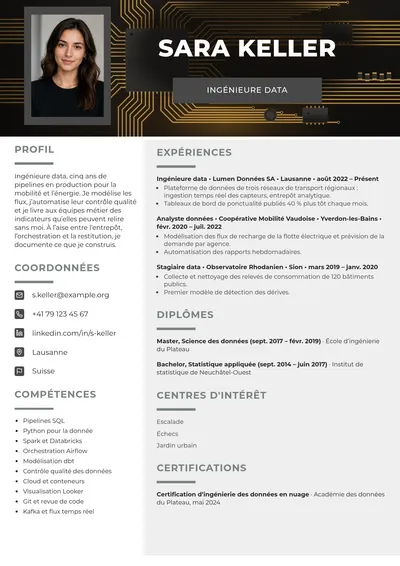
Circuit
Tech
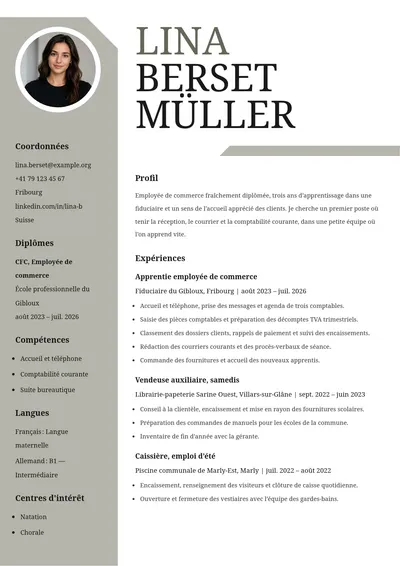
Sage
Elegant
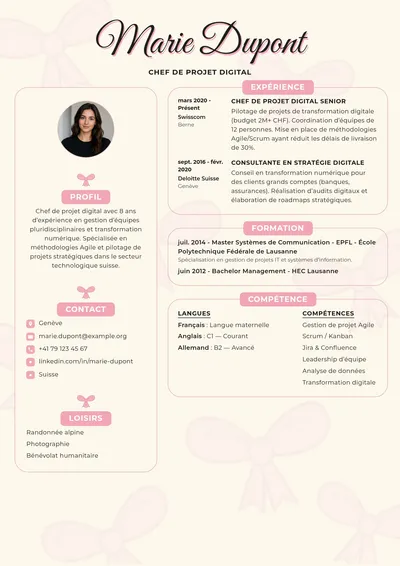
Coquette
Creative
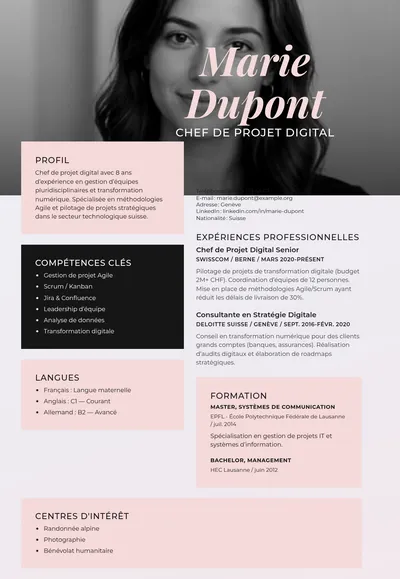
Atelier
Creative
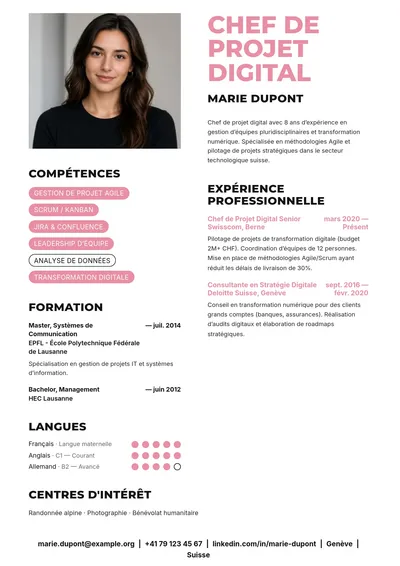
Studio
Creative
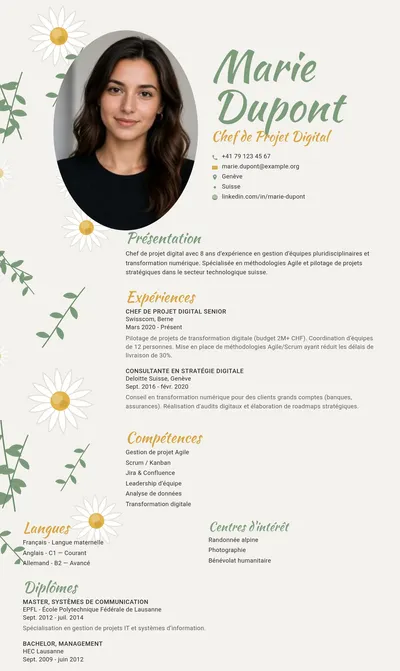
Daisy
Creative
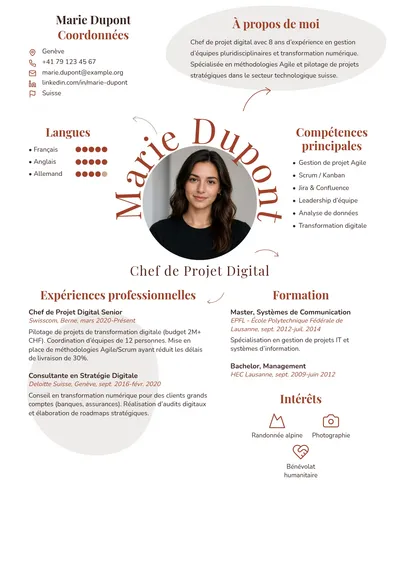
Orbit
Creative
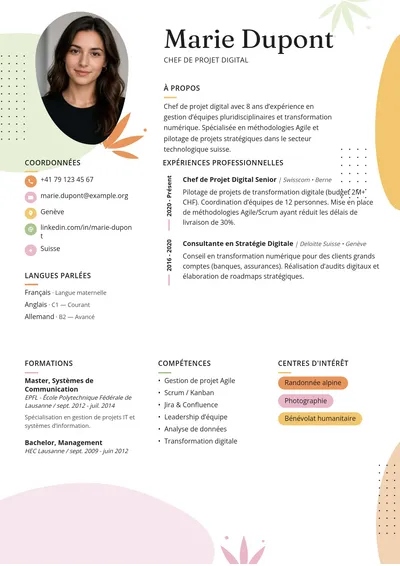
Pastel
Creative
Arc
Decorative
Ribbon
Decorative
Pulse
Dynamic
What our clients say
Thousands of professionals trust us to create their perfect CV
4.9/5
Average rating
10+
Customer reviews
9
5-star reviews
filipe pedro
so far so good. its working fine and the support is there to help
July 2026
panagiotis Maniatis
Excellent!
June 2026
Marcus Burkhardt
absolut perfekt und einfach zu bedienen
June 2026
Marco Reimann
Sehr gutes Tool für die CV Erstellung
einfache Handhabung, bei kleineren Problemen sehr schellen und effizienten Support erhalten.
June 2026
Olivier Sanchez
The best Swiss CV application on the market!
Fast, efficient, inexpensive, in short Impeccable..
Translated from French
June 2026
Albert Shur
Albert
I am very satisfied with this CV Builder. The tool is super easy to use.
Translated from German
June 2026
FAQ
Do I need German to work in Bern?
In almost all cases, yes. The city works in German, and written applications are expected in standard High German even though daily conversation happens in Bernese dialect. A few international, research and IT roles operate in English, but they are a smaller share of the market than in Zurich or Basel. If your German is in progress, state a realistic CEFR level and mention your current course.
Can foreigners work for the Swiss federal administration?
Many federal positions are open to non-Swiss candidates who have the right to work in Switzerland, and the Confederation values staff who cover several national languages. However, some roles - especially in security, defence and other sovereign domains - are reserved for Swiss citizens, and most positions require professional proficiency in German or French. Check the requirements stated in each vacancy on the official federal job portal, https://www.stelle.admin.ch.
Is French really an advantage in Bern?
Yes, more than anywhere else in German-speaking Switzerland. The canton is officially bilingual, the federal administration works across national languages, and many Bern-based organisations serve the entire country. Solid, certified French alongside German strengthens a federal or para-public application in a way it would not in Zurich. List both languages with honest CEFR levels and name any certificates.
How formal should a Bern application be?
Very. Bern rewards the classic Swiss dossier: a sober one-to-two-page CV with photo, nationality and permit, precise MM.YYYY dates, plus a tailored motivation letter, work certificates and diplomas. Avoid creative layouts entirely for federal, cantonal and para-public employers. Treat proofreading as part of the application - administrative recruiters read the quality of your documents as evidence of how you work.
Do I need to understand Bernese Swiss German?
Not to apply, and not to be hired. All written work and formal communication uses standard High German, and colleagues switch for non-dialect speakers. Understanding Bernese dialect comes with time and helps everyday integration, but no employer expects it from an international candidate. What matters on the CV is your written German level, stated honestly on the CEFR scale.