CV for working in Basel: pharma, life sciences and a trinational market
Build a CV that matches how Basel actually hires: German for local employers, English inside the pharma giants, and clear cross-border details if you commute from France or Germany. 45 professional templates, ATS-friendly, PDF export.
Build my Basel CVQuick answer
To work in Basel, prepare a Swiss-format CV of one to two pages with a professional photo, your nationality and work permit, and language skills graded on the CEFR scale. German is the default for local employers and public institutions, while English is the standard working language in scientific and corporate roles at pharmaceutical companies such as Roche and Novartis - many candidates keep both versions ready. Highlight regulated-industry credentials (GMP, regulatory affairs, clinical research) where relevant, and if you commute from Alsace or Baden state your G permit and place of residence. Build an ATS-ready Basel CV at https://www.cv-builder.ch/en/ with 45 templates and PDF export.
The Basel job market: life sciences on a three-country corner
Basel sits where Switzerland, France and Germany meet, and its economy reflects that geography. The city is the historic home of the Swiss pharmaceutical industry: Roche and Novartis are headquartered here, surrounded by a dense ecosystem of life-sciences employers such as Lonza and Syngenta, plus contract research organisations, biotech start-ups and medtech firms like Straumann. Beyond pharma, Basel hosts the Bank for International Settlements, major insurance and logistics players, and the Rhine port - Switzerland's only direct freight connection to the sea - which sustains a strong transport and trade sector. For international candidates this mix matters: it is one of the few Swiss cities where a large share of professional roles operate in English, especially in research, clinical development, regulatory affairs, quality, data and corporate functions. At the same time, the everyday economy - hospitals, SMEs, retail, construction, public administration - recruits in German. Understanding which side of that line your target employer sits on is the single most important decision you will make before writing your Basel CV.
German or English? Choosing the language of your CV
The spoken language of Basel is Swiss German (Baseldytsch), but all written applications use standard High German. Send a German CV when you target local SMEs, healthcare institutions, public administration, trades or customer-facing roles: an English-only application to these employers signals that you cannot work in the team's language. Send an English CV when the job advert itself is in English - common at Roche, Novartis and the international suppliers around them - or when you apply to global functions where English is the documented working language. If you are an expat with limited German, be honest on the CV: list German with a real CEFR level (for example A2 or B1, ideally with a current course) rather than omitting it. Basel recruiters in international companies are used to English-speaking hires, but they still read the languages section first. French is a genuine asset here too, because teams routinely include colleagues commuting from Alsace; mention it if you have it.
Salaries in Basel: read the official data correctly
Salary expectations never appear on a Swiss CV, but you should walk into interviews knowing the official baseline. The table below shows median gross salaries from the Swiss Federal Statistical Office (OFS) for the Northwestern Switzerland greater region, which covers the cantons of Basel-Stadt, Basel-Landschaft and Aargau - so the figures describe the wider region, not the city of Basel alone. Two more caveats apply. First, OFS medians are standardised to a full-time equivalent gross monthly salary, which makes occupations comparable but will not match any individual payslip. Second, the ISCO occupation groups are broad: 'Health professionals', for example, includes physicians alongside nursing specialists, and 'Science and engineering professionals' spans chemists, engineers and IT-adjacent roles. Use the table as orientation for negotiation ranges, then refine with sector sources and the collective agreements that apply in pharma and chemistry.
Photo, references and presentation: what Basel employers expect
Basel applications follow Swiss-German conventions, which are closer to the German Bewerbung tradition than to anglophone norms. A professional photo on the CV remains customary and expected by most local employers; the large international pharma groups are neutral about it, so including a good one is the safe default. Keep the document to one or two A4 pages, dates in MM.YYYY format, experience in reverse chronological order, and state your nationality and permit type near your contact details. References carry real weight in the German-speaking job market: if previous employers issued you work certificates (Arbeitszeugnisse), mention that full references and certificates are available on request, and have scanned copies ready, because they are routinely requested with the application dossier. For regulated roles, list certifications explicitly - GMP, GLP, GCP, regulatory affairs qualifications - since recruiters and ATS filters in Basel's life-sciences sector screen for these exact keywords.
Work permits: what to state on a Basel CV
Basel hires across three borders, so recruiters check permit status early. State it in one clear line: Swiss citizen, settled (C permit), resident (B permit), cross-border (G permit), or EU/EFTA citizen eligible under free movement. If you live in Saint-Louis, Mulhouse, Loerrach or Weil am Rhein and plan to commute, say so explicitly and name your place of residence - cross-border employment is completely normal in Basel and hiding it only creates confusion. Non-EU candidates should indicate their current status honestly rather than leaving the question open. For the full picture of permit types, how to phrase them on your CV and what employers can and cannot sponsor, see our dedicated guide at /en/work-permit-cv-switzerland.
Out of work in Basel: registering with the RAV
If you live in Basel and lose your job, register with the regional employment office (RAV, Regionale Arbeitsvermittlung) as early as possible - ideally as soon as you receive notice, and no later than your first day of unemployment, because benefits and placement support start from registration. The national portal https://www.arbeit.swiss explains the process, lets you register online and hosts the official Job-Room vacancy platform, where positions in occupations with high unemployment are advertised to registered job seekers before the general public. Cantonal information for Basel-Stadt is available through https://www.bs.ch. Note that cross-border workers who lose a Basel job generally claim unemployment benefits in their country of residence (France or Germany), not in Switzerland - but they can still use Swiss placement services for their job search. Bring an up-to-date CV to your first RAV appointment: advisers use it to match you with open positions.
Professions with strong demand around Basel
- Engineers - process, chemical and automation roles across pharma production and the chemical industry: /en/engineer-cv-switzerland
- Nurses and healthcare staff - university hospital, clinics and care institutions recruit continuously: /en/nurse-cv-switzerland
- Logistics professionals - Rhine port operations, freight forwarding and pharma supply chain: /en/logistics-cv-switzerland
- Data analysts - clinical data, real-world evidence and business analytics inside life sciences: /en/data-analyst-cv-switzerland
- Accountants and finance specialists - corporate functions of multinationals, insurers and fiduciaries: /en/accountant-cv-switzerland
Getting past the ATS filters of Basel employers
Large Basel employers screen applications with applicant tracking systems before a human reads them, and the life-sciences sector is particularly systematic about it. Mirror the exact vocabulary of the job advert - molecule classes, methods, quality standards, software - in your skills and experience sections, keep the layout machine-readable, and export to PDF. CV Builder gives you 45 templates designed to pass these filters while staying pleasant for human reviewers, with versions you can duplicate in German and English from the same data, so your two-language Basel strategy does not mean maintaining two documents by hand.
Salaries in the region: Northwestern Switzerland (2024)
Standardised gross monthly salary (full-time equivalent), by greater region.
| Occupation group (ISCO-08) | 1st quartile (P25) | Median | 3rd quartile (P75) | Swiss median |
|---|---|---|---|---|
| All occupations | 5’635 CHF | 7’156 CHF | 9’574 CHF | 7’024 CHF |
| Science and engineering professionals | 7’468 CHF | 9’200 CHF | 11’299 CHF | 8’730 CHF |
| Health professionals | 6’791 CHF | 7’944 CHF | 9’835 CHF | 8’000 CHF |
| Business and administration professionals | 7’316 CHF | 9’257 CHF | 12’272 CHF | 9’509 CHF |
| Information and communications technology professionals | 7’917 CHF | 9’655 CHF | 11’598 CHF | 9’949 CHF |
| Numerical and material recording clerks | 5’115 CHF | 6’057 CHF | 7’131 CHF | 6’035 CHF |
Standardised gross monthly salary: full-time equivalent (4 1/3 weeks at 40h), private and public sectors, all ages, both sexes.
Useful guides
Our articles to help you in your job search

CV and artificial intelligence in Switzerland in 2026
How artificial intelligence is transforming CV writing and recruitment in Switzerland. AI tools, ATS filters and tips to stay competitive on the Swiss job market.

How to write the perfect CV for the Swiss job market in 2024
Discover the secrets to creating a CV that stands out with Swiss recruiters. A complete guide with examples and expert advice.

Cover letter for Switzerland: templates and examples
Learn how to write a compelling cover letter for the Swiss market. Concrete examples and mistakes to avoid.

Remote work in Switzerland: rules, rights, and best practices in 2024
Everything you need to know about remote work in Switzerland: legal framework, agreements with France, and tips for managing it well.

Working in Switzerland as a Cross-Border Commuter
A comprehensive guide for cross-border workers: G permit, taxation, health insurance, and practical tips for commuting to Switzerland.

Spontaneous Application in Switzerland: An Effective Method
Learn how to write compelling unsolicited applications for the Swiss job market. Targeting strategies, follow-up techniques, and proven methods.
Related guides
Swiss CV: the complete guide to creating yours online
Everything you need to write a CV that meets Swiss standards in 2026: format, photo, work permit, ATS rules and regional expectations. 45 professional templates, PDF export. From 1 CHF/month.
CV templates: 45 professional designs for Switzerland
Modern, classic, minimalist, creative, professional, one-page and ATS-friendly: explore 45 CV templates tailored to Swiss recruiters. All included from 1 CHF/month.
How to mention your work permit on a Swiss CV
Permit B, C, G, L, or S: learn where and how to indicate your work authorisation on your CV for the Swiss job market. Complete guide with practical examples.
CV for working in Geneva: international organisations, banking and luxury
Create a CV that fits the two Genevas: the French-speaking local economy and the English-speaking world of international organisations, traders and private banks. 45 professional templates, ATS-friendly, PDF export.
Templates for every profession
Choose from 45 professional templates and customize them to your image

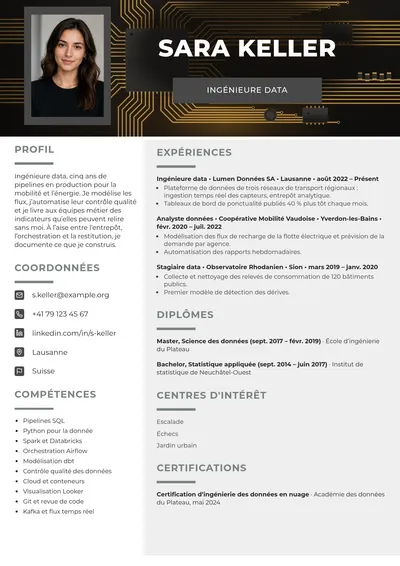
Circuit
Tech
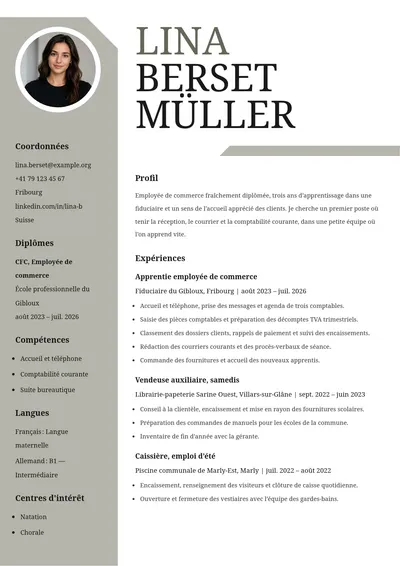
Sage
Elegant
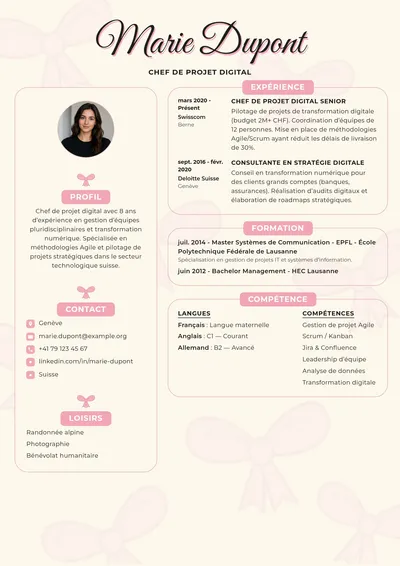
Coquette
Creative
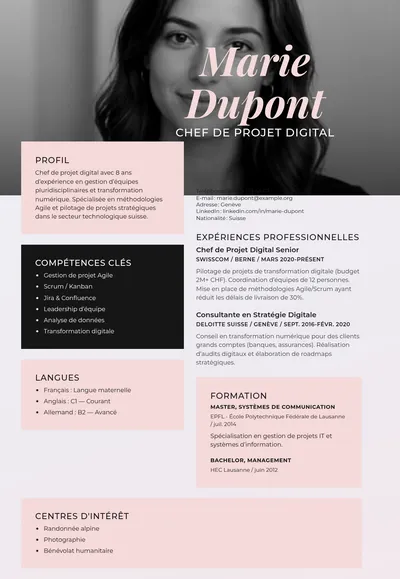
Atelier
Creative
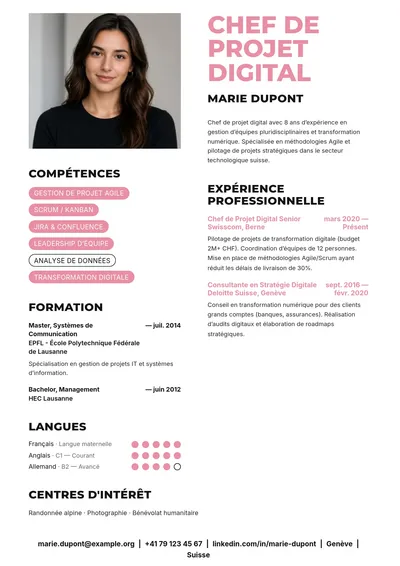
Studio
Creative
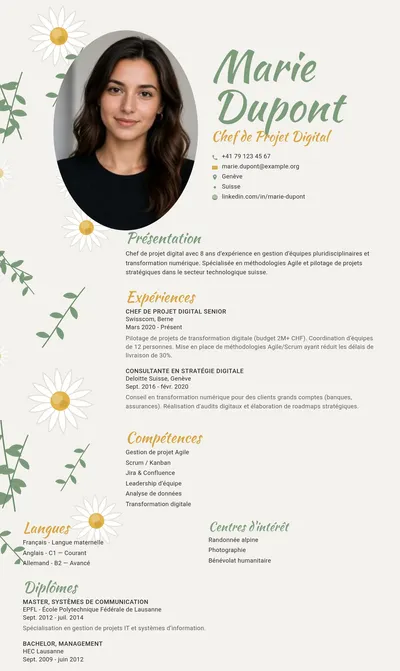
Daisy
Creative
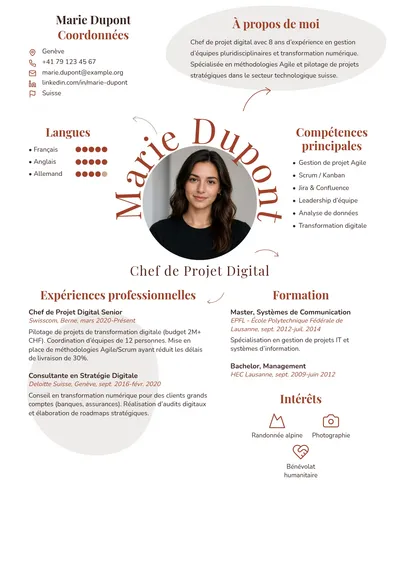
Orbit
Creative
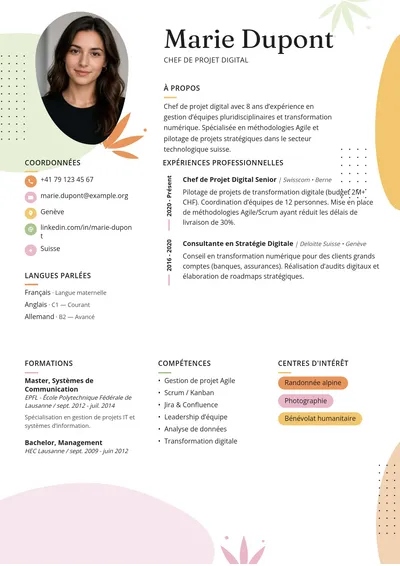
Pastel
Creative
Arc
Decorative
Ribbon
Decorative
Pulse
Dynamic
What our clients say
Thousands of professionals trust us to create their perfect CV
4.9/5
Average rating
10+
Customer reviews
9
5-star reviews
filipe pedro
so far so good. its working fine and the support is there to help
July 2026
panagiotis Maniatis
Excellent!
June 2026
Marcus Burkhardt
absolut perfekt und einfach zu bedienen
June 2026
Marco Reimann
Sehr gutes Tool für die CV Erstellung
einfache Handhabung, bei kleineren Problemen sehr schellen und effizienten Support erhalten.
June 2026
Olivier Sanchez
The best Swiss CV application on the market!
Fast, efficient, inexpensive, in short Impeccable..
Translated from French
June 2026
Albert Shur
Albert
I am very satisfied with this CV Builder. The tool is super easy to use.
Translated from German
June 2026
FAQ
Should my Basel CV be in German or English?
Match the language of the job advert. German is expected by local SMEs, hospitals, public administration and most customer-facing employers. English is standard for scientific, regulatory and corporate roles at the big pharmaceutical companies and their international suppliers. Many candidates in Basel maintain both versions and always include a languages section with honest CEFR levels.
Can I find a job in Basel speaking only English?
Yes, realistically more so than in most Swiss cities, because the pharma and life-sciences ecosystem uses English as a working language for many scientific and corporate roles. Outside that ecosystem - healthcare delivery, trades, administration, retail - German is required. Even for English-speaking roles, basic German helps with integration and is often expected for longer-term career growth.
I live in France or Germany. How do I present that on my CV?
State it plainly: your place of residence, your G permit (or eligibility for one as an EU citizen), and your commuting arrangement. Cross-border employment is an everyday reality in Basel, and employers process G permits routinely once a contract is signed. Trying to obscure a foreign address raises more questions than it answers.
Where do I register if I lose my job in Basel?
Residents of Basel-Stadt register with the regional employment office (RAV); the official portal https://www.arbeit.swiss covers registration, benefits and the Job-Room vacancy platform, and https://www.bs.ch carries cantonal information. Register no later than your first day of unemployment. Cross-border commuters claim benefits in their country of residence instead, while keeping access to Swiss placement support.
Do Basel employers expect a photo on the CV?
A professional photo is still the norm in the Swiss-German application tradition and most local employers expect one. The large international pharma groups are neutral on the question, so a good-quality, recent photo on a sober background is the safe choice. What matters more is the rest of the dossier: work certificates, exact certifications and a clean, ATS-readable layout.